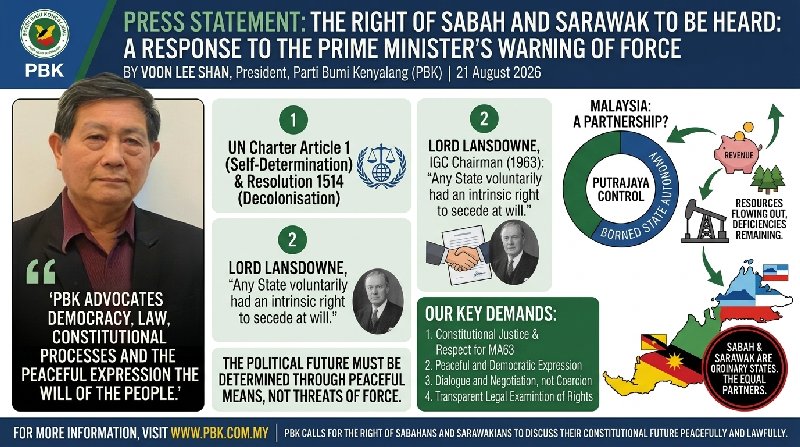
 Parti Bumi Kenyalang (PBK) is deeply concerned by the reported statement of the Prime Minister that force could be used if necessary to preserve the unity and integrity of Malaysia. If the statement is accurately reported, it deserves serious consideration by every Sarawakian and Sabahan.
PBK asks a simple question: why should the legitimate political aspirations of the peoples of Sabah and Sarawak be viewed through the same lens as the Taiwan–China question?
They are not the same historical or constitutional situation.
Taiwan is a complex issue arising from the history of China and the Chinese civil war. Sabah and Sarawak, however, have a different history involving the formation of Malaysia in 1963, the Malaysia Agreement 1963 (MA63), the IGC Report, the Cobbold Commission process and the constitutional arrangements governing the entry of Sabah and Sarawak into the new Federation.
The Prime Minister should study that history carefully before making comparisons.
Sabah and Sarawak were not simply ordinary states of the old Federation of Malaya. Their constitutional position was the subject of extensive negotiations and special safeguards before Malaysia was established.
For more than sixty years, however, many of those safeguards and questions remain matters of political dispute. We are questioning the prime minister of our rights to our revenue, oil and gas. autonomy, immigration, development, representation. constitutional safeguards and ultimately, the dignity and status of the people of Borneo.
IS MALAYSIA A PARTNERSHIP OR A RELATIONSHIP OF CONTROL?
Sarawakians and Sabahans are entitled to ask why so much revenue and natural wealth generated in Borneo continues to be controlled at the Federal level while our people continue to face serious development and infrastructure deficiencies?
If Sabah and Sarawak are genuinely equal partners, then equality must be reflected not merely in speeches but in power, revenue, resources, constitutional protection and respect.
When political and economic power remains heavily concentrated in Putrajaya, while enormous resources flow out of Borneo, people will inevitably ask whether the relationship has developed into something fundamentally different from the partnership that was originally contemplated.
PBK describes this concern as a question of colonialism, centralisation and economic control—not as hostility towards the people of Malaya.
We distinguish between the people of Malaya and the political structures that exercise power over Sabah and Sarawak.
WHAT ABOUT THE RIGHT TO SELF-DETERMINATION?
The United Nations Charter and subsequent General Assembly resolutions recognise the principle of self-determination. Resolution 1514 (XV), in particular, became a cornerstone of the United Nations' decolonisation framework. Resolution 1541 (XV) also addresses principles concerning the status of territories and the exercise of self-determination.
PBK therefore insists on one fundamental principle:
The political future of Sabah and Sarawak must ultimately be determined through peaceful, democratic and lawful means—not through threats of force.
PBK does not advocate violence.
PBK does not advocate armed struggle.
PBK advocates democracy, law, constitutional processes and the peaceful expression of the will of the people.
WHAT DID LORD LANSDOWNE SAY?
There is a historical account that during the discussions surrounding the formation of Malaysia, Sarawak representatives raised the question of whether there should be an express provision allowing a constituent state to leave the Federation.
Lord Lansdowne, Chairman of the Inter-Governmental Committee, was subsequently reported as saying:
“Any State voluntarily entering a federation had an intrinsic right to secede at will.”
That reported statement has been cited repeatedly in discussions concerning the constitutional position of Sabah and Sarawak.
However, PBK recognises that the historical record is not without controversy. The Cobbold Commission material, for example, records that it did not recommend the inclusion of a secession clause.
That is precisely why the matter should be legally examined rather than politically suppressed.
If there is a genuine dispute about what assurances were given, what was understood by the parties in 1963, and what legal consequences follow from those assurances, let the courts determine it.
SARAWAK AND SABAH ARE NOT SEEKING WAR
PBK wants to make its position absolutely clear.
We are not calling for violence.
We are not calling for confrontation.
We are calling for the right of Sarawakians and Sabahans to discuss their constitutional future peacefully and lawfully.
If, one day, the people of Sabah or Sarawak express a genuine democratic desire for a different constitutional status, the proper response of a democratic government should be dialogue, negotiation and law—not threats of force.
A government confident in the strength of its constitutional position should have no fear of allowing these questions to be tested through lawful democratic and judicial processes.
SINGAPORE ALREADY SHOWED THAT THE FEDERATION WAS NOT IMMUTABLE
Sarawakians and Sabahans also remember that Singapore ceased to be part of Malaysia in 1965 following serious political differences between Singapore and the Federal Government.
Whatever one's view of that historical event, it demonstrates that the political arrangements of 1963 were not beyond change.
The lesson for today should therefore be negotiation, not coercion.
PBK'S MESSAGE TO PUTRAJAYA
Do not mistake peaceful demands for hostility.
Do not mistake criticism of Federal policies for hatred of Malaysia.
Do not mistake the demand for constitutional justice for violence.
And do not assume that the people of Sabah and Sarawak will remain silent forever simply because previous generations remained within the Federation.
Our people have dignity.
Our people have history.
Our people have constitutional rights.
Our people have the right to discuss their future.
If the Federal Government believes that Sabah and Sarawak have no lawful constitutional pathway to seek a different status, then let the Government demonstrate the legal basis openly.
If there are competing interpretations of MA63, the IGC Report, the Federal Constitution, and the historical assurances given in 1963, let the courts determine them.
If the people remain satisfied with Malaysia, they will say so.
If they demand genuine equality within Malaysia, that demand must be respected.
And if, through lawful democratic processes, the people eventually demand a different constitutional future, that question should be addressed peacefully and constitutionally—not with threats of force.
PBK believes the future of Sarawak must be decided by Sarawakians, peacefully, democratically and lawfully.
IN QUEST OF INDEPENDENCE — THROUGH DEMOCRACY, LAW AND PEACE.
VOON LEE SHAN
President
Parti Bumi Kenyalang (PBK)