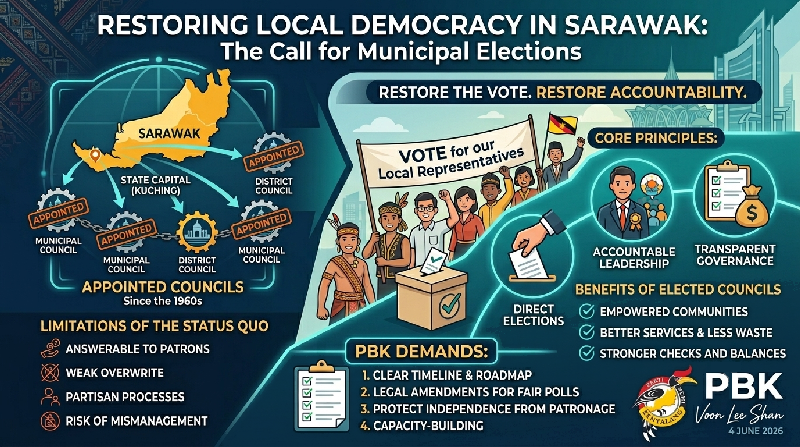
The suspension of local government elections in Malaysia — including in Sarawak — dates from the 1960s. Following the early post‑independence period, federal and state authorities moved to appoint local councillors rather than allow local electorates to choose their municipal representatives.
Over subsequent decades the practice became entrenched: local councils have been filled by political appointment rather than by popular vote. Suspension was justified at the time on grounds of administrative stability and control, and was later sustained with arguments about efficiency, cost and political cohesion. Those are policy choices, not permanent truths.
We state this plainly: the suspension of municipal elections does not represent a democratic endpoint. It is a policy decision that can, should, and must be reversed.
Sarawak suffers when local councils answer to political patrons instead of the people who pay assessment rates and rely on municipal services. Appointed councils concentrate power, weaken independent oversight, and deprive communities of accountability. When councillors are selected through partisan processes, council chambers become extensions of ruling-party machines rather than forums for local problem-solving. That breeds complacency, mismanagement, and the misuse of public funds.
Restore the vote. Restore accountability. Restore local democracy.
PBK demands that the Sarawak Government and the state Legislative Assembly urgently initiate legislation and administrative steps to reinstate local government elections.
This must include:
A clear timeline and roadmap to restore direct elections for municipal and district councils.
Legal amendments and administrative safeguards to ensure free, fair, and regular local polls.
Rules to protect local council independence from patronage, including conflict-of-interest safeguards and transparent procurement and budgeting processes.
Capacity-building for local institutions to manage elections and support newly elected councillors.
To those who argue that local elections would destabilise governance, we respond: democracy is not the cause of instability — the suppression of citizen voice is. True stability rests on legitimate authority, which is earned when leaders are accountable to voters. If cost is invoked as an excuse, note that transparent, electorally accountable councils deliver better services and reduce waste; in the long run, they save public money and restore trust.
Reviving local elections is not a partisan gambit. It is a democratic necessity. It strengthens checks and balances, empowers communities, and improves the stewardship of public resources.
Sarawak is more than capable of handling this reform. Our people deserve to choose those who make decisions about their neighbourhoods, markets, roads, sanitation and local development.
PBK calls on all political actors in Sarawak — government, opposition, and civil society — to place the public interest above partisan calculation and agree on a rapid, transparent process to return municipal elections to the people. The era of appointed, unaccountable local councils must end. The voters must decide.
Voon Lee Shan
4 June 2026