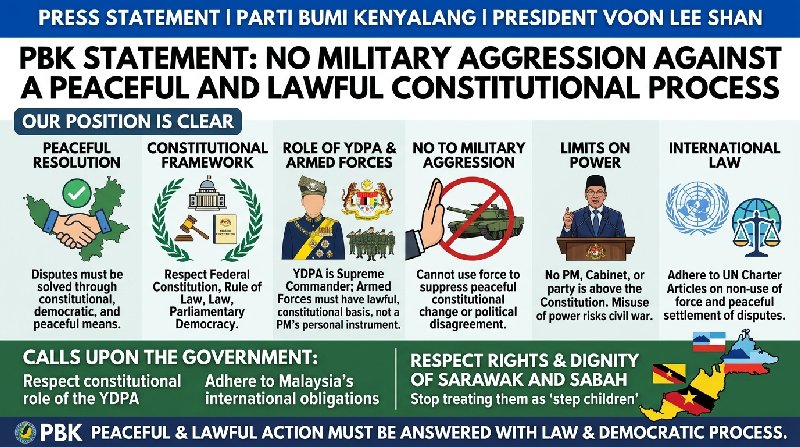
 PBK affirms that any dispute concerning the constitutional status, autonomy, or possible separation of a State must be resolved through constitutional, democratic, and peaceful means—not through military aggression.
The Federal Constitution does not confer upon the Prime Minister a personal or unilateral power to wage war or deploy the armed forces according to his own political decision.
Article 39 places federal executive authority within the constitutional framework, Article 40 governs the exercise of the Yang di-Pertuan Agong's functions on advice, and, critically, Article 41 provides that the Yang di-Pertuan Agong is the Supreme Commander of the Armed Forces.
Accordingly, the armed forces are not a personal instrument of the Prime Minister or of any political party. Any use of military force must have a lawful constitutional and statutory basis and must be subject to the rule of law, constitutional accountability, and parliamentary scrutiny.
Where a State seeks to pursue a change in its constitutional status through peaceful, democratic, and lawful means, there can be no justification for treating that peaceful process as an act of military aggression. Political disagreement, constitutional negotiation, or a lawful claim for greater autonomy cannot, by itself, create a licence for the use of armed force.
If, on the other hand, there is an actual armed attack, violent insurrection, or other unlawful use of force, the Government has constitutional and legal responsibilities to protect the Federation and maintain public order. Such action must nevertheless remain necessary, proportionate, and authorised by law. The Armed Forces Act 1972 provides the statutory framework governing Malaysia's armed forces and recognises circumstances involving active service and war.
The same principle applies under international law. Article 2(4) of the United Nations Charter requires states to refrain from the threat or use of force against the territorial integrity or political independence of states. Article 33 requires disputes that threaten international peace and security to be addressed first through negotiation, mediation, arbitration, judicial settlement, or other peaceful means. The Charter recognises self-defence where an armed attack occurs; it does not provide a general licence to use force simply because a political or constitutional dispute exists.
PBK therefore calls for any dispute concerning the constitutional future of any State to be handled through Parliament, the constitutional institutions, negotiation and, where necessary, judicial or other lawful mechanisms.
PBK says no Prime Minister, Cabinet or political party should be permitted to convert a constitutional disagreement into a military confrontation. The country can be put in danger of a civil war and chaos if a prime minister or political leader does not know his power or the limits of his power in the Constitution or thinks that he can be above the Constitution.
Our position is clear:
Peaceful and lawful constitutional action must be answered with law and democratic process—not military aggression.
Force may be used only where there is a genuine legal basis, such as an actual unlawful armed threat or attack, and never merely to suppress a peaceful and lawful constitutional process.
PBK calls upon the Government to respect the Federal Constitution, the constitutional role of the Yang di-Pertuan Agong, parliamentary democracy, the rule of law and Malaysia's obligations under international law.
PBK also calls on the federal government to respect the rights and dignity of the people of Sarawak and Sabah and should not treat Sarawak and Sabah as “ step children”.