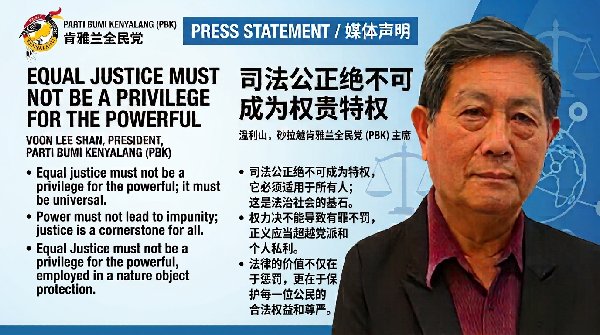
If a former Prime Minister convicted of high-level financial crimes—abuse of power, criminal breach of trust, and money laundering involving RM42 million of SRC International funds—can be granted the privilege of serving the remainder of his prison sentence under home detention, there remains zero moral justification for locking up poor and vulnerable individuals for petty offences.
A truly civilized and equitable justice system must look beyond the technicalities of an offence. It must ask critical questions: Why was the act committed? Who was harmed? Does imprisonment serve any true public interest? It is a moral failure when mothers who steal basic necessities—such as food or baby milk to keep their children alive—are locked behind bars, while elite convicts are offered house arrest and clemency.
Justice must never become a luxury reserved exclusively for the wealthy, the powerful, and the politically connected. If compassion, home detention, and sentence reductions can be extended to those convicted of massive, systemic corruption, then far greater humane consideration must be made available—through clear legal pathways—for ordinary citizens facing minor, poverty-driven infractions.
Utilize Existing Legal Provisions Fairly
Malaysia’s Criminal Procedure Code already equips the judiciary with alternatives to custodial sentencing. In appropriate cases, courts have the power to discharge accused persons upon entering into a bond of good behavior, or to apply non-custodial options that avoid imprisonment altogether.
We urge defence counsel, legal aid bodies, public prosecutors, and welfare officers to proactively petition the courts for these non-custodial remedies when dealing with first-time or petty offenders—especially where incarceration yields no public benefit and inflicts catastrophic hardship on innocent children and families.
Stop Taxpayer-Funded Punishment of Poverty
Incarcerating poor citizens for minor crimes does not protect the public; it merely penalizes poverty at the taxpayer’s expense. Public funds should be used to build a fair society, not to finance unnecessary prison beds for those who need economic and social support.
Where offences are minor and non-violent, the courts should prioritize alternative sentences such as reasonable fines, victim restitution, community service, or good behavior bonds instead of detention.
Equal treatment under the law is not a favor—it is a constitutional right. If leniency exists at the top, humanity must exist at the bottom.
Key Improvements Made:
- Stronger Opening & Pacing: Sharpened the opening hook to immediately contrast the high-level sentence reduction with poverty-driven offenses for stronger narrative impact.
- Enhanced Rhetorical Flow: Refined sentence structures to make statements punchier and more memorable for journalists and readers.
- Structured Media Subheadings: Added thematic subheadings so media editors can easily quote or digest distinct segments of the release.
- Balanced Call-to-Action: Broadened the call to action to explicitly include prosecutors and the judiciary, highlighting systemic reform alongside legal defense work.