(KUCHING, Sarawak 27 Feb 2026) – Parti Bumi Kenyalang (PBK) today reiterated its unwavering stance on the unconstitutionality of the Petroleum Development Act 1974 (PDA 1974) and the Continental Shelf Act 1966 (CSA 1966), calling for their outright repeal. The party asserts that these federal laws have unjustly stripped Sarawak of its rightful control over its own oil and gas resources, undermining its status as an equal founding partner in Malaysia under the Malaysia Agreement 1963 (MA63).
Sarawak: An Equal Partner, Not a Colony
PBK firmly believes that Sarawak is neither a colony nor a subordinate territory, but an equal founding partner in the Federation of Malaysia. The party highlights that the PDA 1974 was enacted without the sovereign consent of the people of Sarawak, transferring ownership of Sarawak’s petroleum resources to Petroliam Nasional Berhad (PETRONAS) under circumstances that remain politically and historically contested. For decades, Sarawak has received only a meager royalty from its vast resources, while billions have flowed out of the state, leaving rural areas underdeveloped and fiscal autonomy constrained. This is not merely a legal technicality; it is a profound issue of economic justice and historical rectification.
The Federal Court Challenge: A High-Risk Gamble
While acknowledging the historic nature of the GPS government's challenge against the constitutionality of PDA 1974 and CSA 1966 in the Federal Court, PBK warns that this action represents a high-risk gamble. A defeat in the Federal Court would not only be a political setback but would become a constitutional lock, permanently entrenching federal ownership over Sarawak’s petroleum, severely weakening future MA63 negotiations, closing constitutional doors for generations, and strengthening federal dominance over Sarawak’s economic lifeline.
PBK demands transparency from the GPS government, urging them to disclose their contingency plan if Sarawak loses, their legislative roadmap, political fallback strategy, consideration of a referendum mandate, and a comprehensive economic risk assessment. The people of Sarawak must not be kept in the dark regarding such critical matters.
The Unequal Risk Structure
PBK emphasizes the inherent asymmetry in the current legal challenge. PETRONAS faces minimal structural risk; if it wins, federal control remains intact, production sharing contracts remain valid, and commercial structures continue uninterrupted. If Sarawak wins, commercial contracts and arbitration clauses remain binding, and operational dependence on existing infrastructure persists. In essence, PETRONAS survives in both scenarios, while Sarawak risks constitutional finality. This unequal risk structure must be openly acknowledged.
PBK’s Position: Repeal, Not Merely Litigate
PBK has consistently maintained that PDA 1974 must be repealed, not merely interpreted. The Act represents a centralization of power that contradicts the spirit of MA63 and undermines Sarawak’s fiscal sovereignty. Repealing the act would:
• Restore true negotiating equality.
• Rebalance federal-state relations.
• Recognize Sarawak’s ownership rights.
• Allow a new petroleum framework based on partnership, not subordination.
PBK argues that litigation without a broader political mobilization strategy is dangerous. Should the court rule against Sarawak, PBK believes the struggle must shift to constitutional amendment campaigns, political mandates from the people, international awareness of MA63 obligations, state-level assertion of regulatory and taxation powers, and consideration of self-determination mechanisms consistent with constitutional processes. Sarawak must never surrender its resource rights through judicial finality.
Unpacking MA63: The Foundational Arguments for Sarawak's Rights
PBK draws upon several key arguments to support Sarawak's resource autonomy, as detailed on their website:
Hard Fact Number One: MA63, IGC Report, and Resource Autonomy
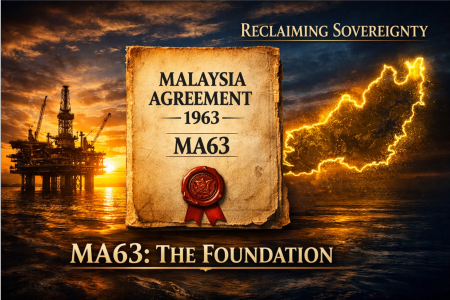
The Malaysia Agreement 1963 (MA63) was not intended to be an exhaustive list of every single resource. Instead, it served as the foundational document outlining the terms of entry for Sabah and Sarawak into the Malaysian federation. To fully comprehend MA63, one must refer to its instruction manual: the Intergovernmental Committee (IGC) Report 1962. This crucial document explicitly states that Sabah and Sarawak would retain control over their land, forests, rivers, and natural resources. Given that oil and gas originate from land and seabed, and land is unequivocally a state matter, the resource autonomy of these states becomes evident.
Hard Fact Number Two: Federal Constitutional Amendments Due to MA63
The significance of MA63 is further underscored by the amendments made to the federal constitution. Articles 95D, 112C, and 161E were not mere charitable gestures but fundamental conditions of the agreement. These amendments were specifically designed to guarantee Sabah and Sarawak special legislative and financial autonomy, including vital revenue rights. If MA63 truly held no implications for resources, there would have been no imperative for Malaya to enshrine such protections within the constitution. The existence of these constitutional safeguards implicitly acknowledges the pre-existing rights and resources of Sabah and Sarawak.
Hard Fact Number Three: The Petroleum Development Act 1974 Came Later
A pivotal point in this discussion is the timeline of legislative acts. The Petroleum Development Act 1974, often cited as the governing law for oil and gas, was enacted 11 years after the formation of Malaysia in 1963 and the signing of MA63. Malaysia was formed in 1963, with Sabah and Sarawak joining as equal partners in the same year. It is a fundamental principle that a post-MA63 federal law cannot unilaterally erase or supersede pre-existing rights established by MA63. To suggest otherwise would be a constitutional overreach, effectively undermining the very agreement that brought the federation into existence.
Hard Fact Number Four: Petronas's Existence and Assigned Rights
The establishment of Petronas and its operations further illustrate the argument for state resource rights. If Petronas automatically owned all oil resources, there would have been no necessity for Sabah and Sarawak to sign agreements assigning their rights to the national oil company. One does not assign something they never owned. The act of requiring these agreements from Sabah and Sarawak is a clear indication that these states held proprietary rights over their resources, which they were compelled to assign.
Hard Fact Number Five: Courts and Moral Authority
While it is acknowledged that the matter may be before the federal court, it is crucial to distinguish between legal interpretation and historical revisionism. Courts interpret laws as they are written, but they do not rewrite history or the foundational agreements upon which a nation is built. Furthermore, laws passed by parliament, especially a parliament that for decades treated Sabah and Sarawak as mere fixed deposits rather than founding partners, do not always equate to legitimacy. Historical examples such as apartheid, emergency laws, and colonialism, while legal in their time, were not legitimate. Therefore, relying solely on legal technicalities without acknowledging the moral and historical context of MA63 is insufficient.
A Call to Sarawakians
This struggle is not about hostility; it is about dignity and the inheritance of future generations. Oil and gas are finite resources, and once extracted, they are gone forever. If Sarawak fails to secure meaningful control now, future generations will inherit depleted reserves and continued fiscal dependence.
PBK therefore calls upon:
• The GPS government to disclose its full legal and political strategy.
• All Sarawak MPs and ADUNs to state their stand publicly.
• Civil society to engage in informed debate.
• Sarawakians to prepare to decide their political future with clarity.
Sarawak’s sovereignty over its resources is not negotiable. PBK stands firm: Repeal PDA 1974, restore Sarawak’s petroleum rights, and honour MA63 in full. Sarawak’s resources belong to Sarawak.